
Breadcrumb Trail Links
PMN Business
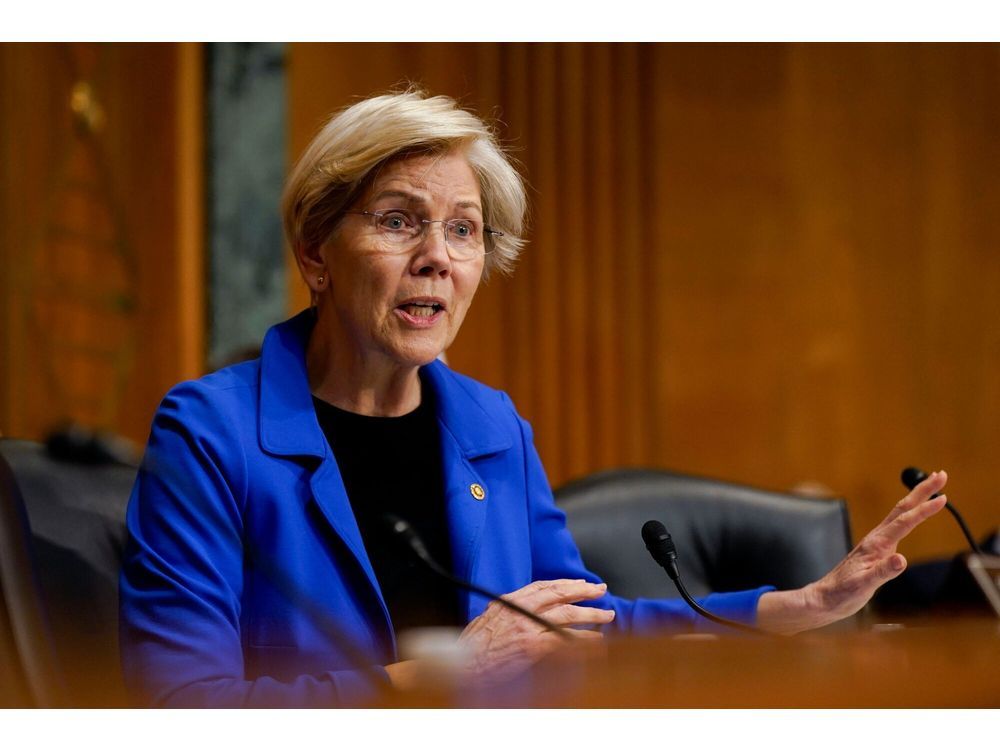
Today on the Big Take podcast: Host David Gura interviews Warren about Democrats’ strategy, the Signal chat leak, Elon Musk’s DOGE and more.
Author of the article:

Published Mar 26, 2025 • 23 minute read
Article content
(Bloomberg) — Never miss an episode. Follow The Big Take daily podcast today.
Article content
Article content
Senator Elizabeth Warren has been shaping US policy for years. She helped create the Consumer Financial Protection Bureau after the 2008 financial crisis, has been a senator since 2013 and ran for president in 2020. Today, she’s a key voice in the Democratic Party’s opposition to President Trump’s agenda and the priorities of a Republican-controlled Congress.
Advertisement 2

Article content
Ahead of Thursday’s confirmation hearing of Trump’s Securities and Exchange Commission Chair nominee, Paul Atkins, Big Take host David Gura sat down with Warren for a wide-ranging interview on regulatory independence, the future of the Democratic Party and the Signal group chat leak.
Listen and follow The Big Take on Apple Podcasts, Spotify or wherever you get your podcasts.
Terminal clients: click here to subscribe.
Here is a lightly edited transcript of the conversation:
David Gura: As the Democratic Party ramps up its opposition to President Trump’s agenda, to the priorities of a Republican-controlled Congress, and to the role of DOGE, along with Elon Musk, a few Democratic members of Congress have emerged as leading voices. One of them has been central to discussions over financial regulation, government accountability, and the future of the Democratic Party itself: Massachusetts Senator Elizabeth Warren. Warren has been a longtime advocate for strong regulations. She helped create the Consumer Financial Protection Bureau after the 2008 financial crisis. She’s been a US senator since 2013. And in 2020, she ran for president. Today, she sits on the Senate’s Armed Services and Finance committees, and she’s the top Democrat on the Senate Banking Committee. That means she’s played a lead role in vetting Trump’s nominees for key positions in his administration.
Advertisement 3
Article content
Warren: Will you put your money where your mouth is?
Warren: Is there any billionaire rich enough who you wouldn’t support a tax cut for?
Warren: Are you willing to commit right now that you will put enough people back to work so they can do the job of delivering the benefits that Americans earned?
Gura: Warren has gone viral for some of those moments…and that’s helped make her a prominent face of Democrats’ pushback on Trump at a time when the party is in the midst of debate over its leadership and its future. And so I wanted to sit down with Warren to get her sense of, well, everything that’s happening now… from Trump’s efforts to reshape the federal government and the regulatory landscape…to this week’s explosive news that Secretary of Defense Pete Hegseth shared information about US military operations in a Signal group chat, and where Warren thinks the Democratic Party is headed. I’m David Gura, and this is “The Big Take,” from Bloomberg News. Today on the show, my conversation with … Senator Elizabeth Warren, which has been lightly edited and condensed. I sat down with her in a hearing room on Capitol Hill.

Top Stories
Article content
Advertisement 4
Article content
Gura: I wanted to ask you first of all about what we’ve been learning about. The editor of the Atlantic found himself in a chat with some of the most senior members of President Trump’s administration, national security staff. And by virtue of that was privy to plans for an attack in great detail.
Warren: Right.
Gura: Your reaction to it? You sit on the Senate Armed Services Committee.
Warren: So let me just start with, if Pete Hegseth had a shred of self-respect and decency, he would resign. That’s what leadership is about. And instead Pete Hegseth thinks it’s all about, oh point at somebody else and minimize the problem and sweep it under the rug and deflect. You know, you wanna be a leader of the finest armed forces in the world, then step up and take some responsibility.
Gura: Should he be fired? You talk about him resigning.
Warren: Yeah. If he won’t quit, then he should be fired. Because he has put our national security at risk. That’s part one. Part two is you realize a bunch of this is potentially certainly breaking the law. So, for example, because of the Freedom of Information Act, there are laws that require that people in the administration, all of them, have to preserve the records of their texting back and forth. I know this from the days when I served in the administration and we were carefully cautioned about the importance of preserving records. Signal, as you know, disappears those records. And, and I will say on this, when I read how casually they just formed this chat, notice that’s how you refer to it, right, to discuss the national security issues and the bombing of another country, how many other times are they using Signal and what are they using it for? So this is a moment, we need some of those congressional investigations. We need a hearing in the Senate. We need a hearing in the House. I remember all of the hearings before when there was a question about Hillary Clinton’s emails. I want to run the tape on how many Republicans talked about the importance of accountability and getting to the bottom of this. Where are they right now? I’m ready for those hearings and the FBI needs to step up.
Advertisement 5
Article content
Gura: This was a chat that was organized by Mike Waltz, the President’s National Security Advisor, and he addressed this in an interview on Fox News. Here’s what he said.
Waltz: We made a mistake, we’re moving forward …
Gura: I noted that, by and large, the response to the administration has been, there wasn’t classified information here. And as a result of that, The Atlantic released screenshots of a lot of these conversations, we learned that there was information about planes, timing of this attack. You talk about the need for hearings. Are you optimistic that that’s going to happen and that you’re going to get to the bottom of what was in fact discussed on that chat?
Warren: So I think this is a question fundamentally about where is power in this country? I get it. Elections, we pick a president, president picks a team, and that’s where power resides in terms of the execution day to day of various policies. But ultimately it’s people across this country. And when people across this country say, wait a minute, the Secretary of Defense, I mean this is, this is not some random guy off the street who stumbled across some secret information and kind of didn’t know how to handle it. This is the Secretary of Defense. And those candid conversations need to be shielded from the rest of the world. When the White House wants to say nothing to see here, just flip it the other direction and ask yourself if The Atlantic had called the White House and said, let me show you what we’ve got in advance of the bombing. You guys okay if we put it up on our website? How many heart attacks would there have been over at the White House saying, no, no, no, no, no. You can’t do that. Well, if it wouldn’t have been okay for The Atlantic to publish all of that in advance. You gotta worry, it’s not published on a website, but I don’t know who’s listening on Signal. The Chinese, the North Koreans, the Russians? Some other bad actors out there? It is important that we follow through as a nation and say, look, you put our whole country at risk, our allies. I’m getting asked in the hallways by foreign reporters, can we actually trust the United States of America? If we tell secrets, are they gonna end up on some Signal chat with the Secretary of Defense? So there needs to be an investigation, but there needs to be some accountability. And the accountability should start right now. Hegseth should resign, and if he won’t do that, then Trump should fire him. He knows how to say you’re fired.
Advertisement 6
Article content
Gura: I wanna ask you about the moment that we’re in.
Warren: Sure.
Gura: This is part of that moment, we’re two months into this administration’s tenure. How are you thinking about the role of the Democratic Party in this moment? And just its gravity overall for the country itself.
Warren: So let’s set the table for this moment. Donald Trump ran for office saying over and over and over and over and over, I will lower costs on day one. Those were his words, not mine. I will lower costs on day one. He said that to millions and millions of people. And right after he got elected, he was interviewed, his very first interview, he said, that’s how I got elected, was saying, I’m gonna lower costs on day one. So here we are, two months in. He has done nothing to lower costs. I mean, no. All that’s happening is we’re watching places where costs are going up, up, up. But he and his co-president, Elon Musk, have been out there with a chainsaw moving through government, trying to fire the financial cops, for example, by trying to shut down the Consumer Financial Protection Bureau. Laying off tens of thousands of federal workers who kind of do the job of Social Security, making sure people get their Social Security checks each month. Ending contracts for medical research. So there’s this — and playing red light, green light with tariffs, right? Yes, there’s a tariff. No, there’s not a tariff, right? Playing that game. So it’s important to remember we’re in a system right now that is deeply chaotic. I think of it like a sandstorm, you know, the sand is blowing everywhere. I think the job at the Democratic Party right now is to say there’s a lot going on. We are in the fight. We are in the fight to save Social Security. We are in these fights. But to pull back and to look at the bigger picture. The media will do the day by day fights, but our job is to pull back. And the bigger picture is that other promise that Donald Trump made when he was running for president. Remember, to millions of people, he said, I will cut your costs on day one. To a handful of what he called his rich as hell donors, he said, I’m gonna give you tax breaks like you’ve never seen before. Mostly sucked up by billionaires, billionaire corporations, and then paid for on the backs of elderly people in nursing homes who will lose federal support. Your neighbor down the street who has a disability and needs a home health aide paid for by the federal government, kids in public school, uh, who need help, and those public schools need help, cutting scientific research and medical research. And that sets up what this fight is all about. Are we gonna be a nation that hands over $4.7 trillion in giveaways to a handful of billionaires and makes everybody else pay for it? Or are we gonna be a nation that says no to tax cuts for those guys and says, we’re gonna invest in an America where everybody gets an opportunity.
Advertisement 7
Article content
Gura: Coming up next, I ask Senator Warren about her colleague, Senate Minority Leader Chuck Schumer. And how she sees her own position in the Democratic party.Gura: The leader of Democrats in the Senate, Chuck Schumer has a book out. So he’s been talking a lot and something he’s brought up over and over again is he doesn’t think that we’re at a constitutional crisis yet. I wonder if you agree with him in that regard, and if so, what is the threshold when we would be facing one?
Warren: So I have to say, before we got here, in the last two months, I would’ve described a constitutional crisis as like a light switch. You’re not in one. You’re not in one. You’re not in one. And then flick.
Gura: All of a sudden—
Warren: All of a sudden you are in one. I’ve come to think about that differently. I worry that we move increasingly toward an administration that’s not just saying, I’m gonna be a more robust president. And I get it, presidents look at this differently. Some a little stronger, some a little weaker. But a president that says, there are no constraints on me. And that takes me back to Constitutional Law 101. Legislature writes those laws, that’s our part, Congress. The administration, president, and those who work in the administration, administer those laws, and the courts have the responsibility if the administration steps outta line to say, you violated the law. We keep all three parts in balance, and I’m watching Donald Trump and Elon Musk say, no, there are not three equal branches of government. It’s just one. That smells a lot like a constitutional crisis.
Advertisement 8
Article content
Gura: We’ve just been through a moment when Republicans wrote a continuing resolution and Chuck Schumer said the Democrats should support it. He did. You did not, I should say. You did a town hall in Lowell, Massachusetts. WBUR was there and recorded it, and I got tape of what you said.
Warren (tape): I think Chuck Schumer is wrong.
Gura: You didn’t linger on that, and I wonder if you might hear, just for, for a moment, was he wrong about the political calculation? Spell out for me what you disagreed about what he did in particular.
Warren: I think there’s a moment when you stand and fight. And for me, that moment came with a continuing resolution.
Gura: It was a squandered opportunity to do that?
Warren: It’s more than that. Understand, let’s go back to what we were talking, what is the big fight right now? The big fight is going to be whether or not the billionaires and Donald Trump and Elon Musk are just gonna take over our country and run it to suit themselves. Make everybody else pay for it. That’s what the budget is all about. We do a lot of other things in Washington, but you wanna know our values? Take a look at the budget. And so the question becomes, in this fight we gotta stop and draw the line and say, it’s time. It’s time for us to fight back. It’s time to call on people of the United States because that whole constitutional structure that I was talking about, the three parts of government, all rest ultimately on the people. And it is time to have that fight.
Advertisement 9
Article content
Gura: Did it cause you to reevaluate your faith and confidence in Senator Schumer as a leader of Democrats in the Senate?
Warren: I wanna be clear. We are heading into a fight where we need every single Democrat pointed the same way. We may still be bumping around on exactly what the timing is gonna be on that fight, exactly where the trigger point is going to be, but there is no doubt in the United States Senate, the 47 of us are locked arms and moving in the same direction. And the same is true over in the House. This fight is on top of us. We cannot avoid this fight. Because Donald Trump and Elon Musk truly, they want to take this country over for just a handful of people, and they want even more wealth and more power to go to them while everybody else has to pay for it. That is the fight.
Gura: Last question on this subject.
Warren: Sure.
Gura: What is your role as you see it in that fight? You, you write a lot of letters to administration officials.
Advertisement 10
Article content
Warren: Yeah.
Gura: You speak out quite a bit. You are somewhat, I think, identifiable with this oversight fight and struggle with the administration. How do you see your role in the Democratic Party broadly today?
Warren: Look. I look at what are the tools in my toolbox? I’ll use every one of them that I possibly can. Oversight is a big part. This is part of your job when you’re a Senator. And that is to look at the agencies, uh, to ask questions of these nominees, to get them on the record, to press them, to ask for investigations. This is why we need inspector generals. This is why we need an active GAO. This is why we need an FBI that is still functional. It’s partly just to say we already have laws. Enforce the damn laws. Make sure that people are doing that. That’s part of my job. Part of my job is to be in the fight. To give it everything I’ve got. Because as I said, ultimately it’s gonna be about people across this country saying, look, I don’t want an America where it’s all about a handful of billionaires. I want an America where we actually do invest in medical research. I want an America where, actually, every kid has an opportunity to go to public school. Even kids who have special needs. You hear me talking as a special needs teacher. I want an America where we’re making investments in our best resource, and that is our people.
Advertisement 11
Article content
Gura: I’m talking to a former law professor. So, Article Two, Section Two, power of advice and consent.
Warren: Yeah.
Gura: By virtue of the committees that you sit on, Armed Services, Finance, Banking, you have had the ability to question a lot of these high-profile nominees. Coming up is the president’s pick to head the Securities and Exchange Commission, Paul Atkins. And you’ve written a memo, 34 pages in length. It starts with a congratulations.
Warren: It’s about average for me.
Gura: You say he has extensive experience in financial services and capital markets, but I have concerns about your record.
Warren: Yeah.
Gura: You tick through what he’s done as an SEC staffer and commissioner and the work that he’s done since in the private sector as a consultant. He did work on behalf of FTX, the fraudulent and failed crypto conglomerate that Sam Bankman-Fried started. You point out things he said about crypto and climate regulations. Given all of that, is there anything that he could say to earn your vote in committee?
Advertisement 12
Article content
Warren: So, let me back up just a little bit. Think about the job that he’s being interviewed for here.
Gura: Top cop on Wall Street.
Warren: Top cop on Wall Street and cop in two meanings of that word. One is you gotta catch the fraudsters, you gotta make sure everybody’s dotting their I’s and crossing their T’s because there’s a lot of value in having that stock market be an honest and level playing field. But the other way in which top cop, it’s to watch for risk building up in the system. It’s to make sure that the regulations that are in place are appropriately calibrated to deal with those risks and beat those risks out of the system. Paul Atkins actually has a track record on exactly that issue because he served as a commissioner in the SEC from 2001 to 2008. You remember what happened there?
Gura: Financial crisis. Yes.
Warren: So here we are in the lead up to the financial crisis. And over and over again, what does Paul Atkins vote for? Loosen the regulations.
Advertisement 13
Article content
Gura: What does his nomination say to you about the regulatory framework this administration wants?
Warren: Oh, I think, I think this is entirely in keeping with what Donald Trump and Elon Musk wanna see us do. And that is loosen regulations, loosen regulations, loosen regulations. That is what Paul Atkins did. He also said repeatedly that no, regulations just get in the way. Everybody needs to do whatever they want. Those big Wall Street giants. We saw the crash in 2008 and here’s what happens next. After the crash, he has the chance to have a little 20-20 hindsight. He has 20 zero hindsight. He looks back and says, nope, no problem with having let those giant Wall Street banks run wild and the fact that the American taxpayer had to bail ’em out, not a problem. That’s my concern. If someone has demonstrated such poor judgment, you gotta be really worried about putting them in a job where the failure to have good judgment could be like it was back then. Remember, 10 million families lost their homes. Millions more people lost their jobs. We watched Wall Street do a real tank then. And here’s the thing about Paul Atkins. We have both his demonstrated experience, but also look at his experience overall. So his time in government is a real problem, but now he’s someone who has built a very lucrative business, uh, with Patomak Partners. He charges evidently upwards of $1,200 an hour to give advice, and he says, well, I’m gonna divest this interest, but he doesn’t wanna tell us who he’s divesting to. Who’s buying it? And for what purposes? And what are the long-term plans? Because here’s the deal, SEC chairmanship doesn’t last forever, right? Two years, four years, maybe longer. My concern is, and so what happens on the other end? Does he just come right back out and instead of charging $1,200 an hour, it’s now $2,400 an hour. But it’s who do you work for? And why that matters is it has an effect on the time you sit as chairman of the SEC. So there he is making decisions. And I look at someone like Paul Atkins. How much time has he spent with families that are working three jobs to try to make it to the end of the month. How much time has he spent with any of those 10 million people who lost their homes in the last crash? And how much time has he spent with this handful of billionaires who really, at least in the short run, love these deregulated markets and taxpayer bailouts? And how much, when he makes a decision, is he thinking about the guy working three jobs and how much is he thinking about his future clients whom he could please while he’s at the SEC. So those are the problems for me.
Advertisement 14
Article content
Gura: After the break, my final questions for Senator Warren on the independence of regulators, and the judicial branch’s role in the balance of power in Washington.
Gura: Something about which I know you’re passionate is the independence of these regulatory agencies.
Warren: Oh yeah.
Gura: You look at the SEC today, there are two Republicans on that commission. One Democrat whose term will be up soon. There’s been no indication the president’s gonna put forward another Democratic nominee. I look at the FTC, the Federal Trade Commission, and the two Democratic members were removed by this administration, they’re fighting to get back in those positions. What is the practical implication of that? Not having five members in place, not having the kind of, I imagine ideological political diversity you would have under, under normal circumstances.
Advertisement 15
Article content
Warren: Right. You know, I’m glad you asked that because it’s a reminder that when those agencies were designed, FTC, of course the oldest, the SEC, during the Great Depression, they were made bipartisan from the beginning in an understanding that, yeah, it’s gonna move a little, there’s gonna be a little shift, but we need buy-in across the political spectrum, and we need the stability all the way through the entire system. I think of it this way, even for companies that are saying, let’s deregulate, you know, turn us loose, let us do whatever we want. At the end of the day, yeah, that may feel good in the short term. You may be able to figure out how to cut a corner here and make a little more money. But understand, the reason our stock market is so valuable is in part because it has level, transparent rules that are strictly enforced. And you start to weaken that, and in the short run you may make a profit and that guy over there, but how many other people say, you know what? I don’t think that’s where I wanna invest my money. I think I’m just gonna slow down on how much of my wealth, my energy, my time, my talent I put in there. We have built a legal structure. That in many ways is the envy of the world. There’s a reason investment comes into the United States, and it’s because you count on those structures independent of whether you’ve got a Democrat or a Republican in the White House. The structures work. When Donald Trump and Elon Musk come in and don’t just say, you know, let’s, let’s give a little different emphasis, but they want a chainsaw, they wanna just get rid of everyone who doesn’t follow their deregulatory agenda, their boost the billionaire agenda, that’s gonna cost everybody in this country.
Advertisement 16
Article content
Gura: I wanna stick with the FTC and what happened there.
Warren: Sure.
Gura: Because we’ve heard from the Fed chairman with whom you’ve had your sheriff of disagreements, I should say, over policy.
Warren: I have. But not over his independence.
Gura: Not over his independence. And that’s where I want to go. Should he be worried as he watches what happened at the FTC about his and his colleagues’ ability to keep their positions in the Federal Reserve?
Warren: You know, I wanna say no, he shouldn’t be worried because I stand staunchly behind the independence of the Fed. But damn, I stand staunchly behind the independence of the FTC and behind the independence of the SEC within their statutory, uh, neighborhoods. But that’s the question. If Donald Trump can just start getting rid of everyone who disagrees with him anywhere in government, it for me, it started actually with the inspectors general. If he can just fire those inspectors general, even though the statutes say that they have job protection and can only be fired for cause, if he can just mow through every civil servant, if he can just mow through the Consumer Financial Protection Bureau. It’s a form of lawlessness, and all the power belongs to the king, that it suggests nobody is safe, not even the chairman of the Federal Reserve.
Advertisement 17
Article content
Gura: I’m gonna guess that the person you’d most like to have in a seat in front of you in a hearing room is Elon Musk, who of course is not a cabinet appointee.
Warren: That’s right. In fact, what is he, can you just tell me? I read court documents and I hear that he’s nothing. He’s just the guy who stands here in the White House.
Gura: But it gets to this issue of who does hold him to account.
Warren: Yeah.
Gura: And in your capacity as senior senator for Massachusetts, ranking member of the banking committee, how do you get answers from somebody who, again, has no official position, traditional official position, but is doing so much to reshape the bureaucratic landscape, the regulatory landscape, in fact the whole government?
Warren: Yeah. So let me do two parts here. The first one is, I wanna remind you, after Donald Trump was elected, one of the very first letters I wrote was to Elon Musk. And I said, I’ve read the declaration. You wanna cut $2 trillion from the budget, which he then trimmed down to a trillion, which he then trimmed down to half trillion. I said, don’t give up. Don’t give up. You can cut $2 trillion in waste and fat out of the budget. And here’s a list of 30 things that I’ve been working on for a long time here in Congress that I’ve seen, kind of an insider’s view on some of this, places where we could make cuts that would make our government actually more efficient, that would make our government work better. You wanna go to work? I’m ready. I’m ready. And you don’t have to promise to do all 30, just pick any of ’em. This is a menu. Just take whatever you like on this. No answer. And instead, he goes out and just starts firing people. And, and now this moves into the second part of the answer. He does things that are illegal. And there’s just, there’s just not much doubt about this. He fires people who, under law, have certain job protections, can only be fired in certain ways. He goes out there and cancels contracts, government contracts, that can only be canceled by a federal contracting official. I mean, look at the laws, just boring old laws about this stuff. So what we have is a lawlessness that has been set through our entire government and this is a threat to democracy. It is also a threat to our economy. You can’t build a strong and stable economy in the middle of this. It is also a threat, damn it, to good government. I go back to my list. There are things I really wanted to cut. I’ll tell you something else I wanna do. I think we ought to have simpler regulations. I’m not a no regulations gal, but I am definitely, there are a lot of places we should simplify our regulations, make ’em clearer, easier to understand, there are things we could do to run this government better. And in that sense, I wanna cheer when someone says, I wanna be a reformer, but you gotta be a reformer within the law. That is possible right now. Republicans are in control of the House, the Senate, the White House. You guys wanna do reform, pass some damn laws, but do not set Elon Musk to take a chainsaw to cancer research in America and put old people out of the nursing homes that they’re in. That is not how America builds a future, and frankly, that is not the kind of people we wanna be.
Advertisement 18
Article content
Gura: Last question here, we’ve talked about the three branches of government. Let me ask you about the judicial one in particular, drawing from your experience, again as a professor of law. Are you confident that the courts will be able to keep up with all of the challenges that we’ve seen here? There has been this flurry, the sandstorm as you described it. Can the courts keep up?
Warren: It’s tough. Look, we’re at over a hundred lawsuits. I no longer can keep the number in my head ’cause it, it keeps shifting. But the judges, by and large, have stepped up. Courts are designed to go slowly, right? And Elon Musk is moving fast, right? You can break laws a lot faster than you can actually hold people accountable for that. But at the end of the day, the three parts of government: Congress writes those laws, the administration administers those laws. We count on the courts to hold the first two to their roles. I think the judges are stepping up. So I say this half outta hope, but half out of conviction. I still believe in the constitution of the United States. I think most judges do, and I think they’re gonna hold.
Article content
Share this article in your social network