Breadcrumb Trail Links
PMN Business
Donald Trump said the US should take control of the devastated Gaza Strip, shunt the area’s residents to other countries and turn it into a “Riviera,” a proposal that drew sharp opposition from Palestinian and other Arab officials.
Author of the article:

Published Feb 05, 2025 • 7 minute read

Article content
(Bloomberg) — Donald Trump said the US should take control of the devastated Gaza Strip, shunt the area’s residents to other countries and turn it into a “Riviera,” a proposal that drew sharp opposition from Palestinian and other Arab officials.
Article content
Article content
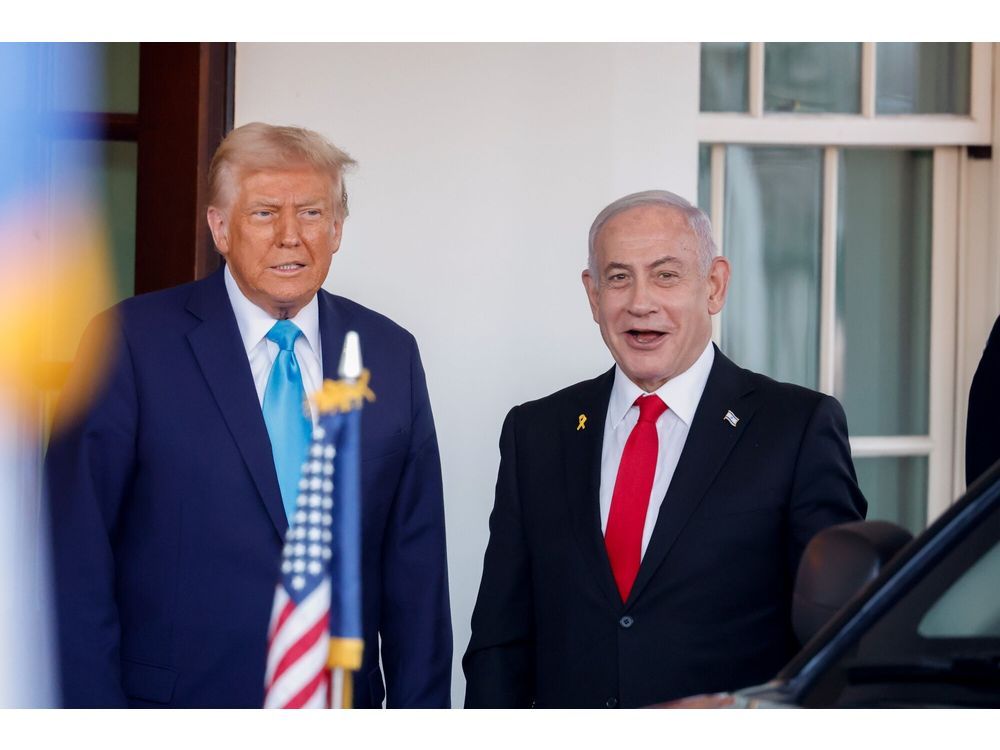
“The US will take over the Gaza Strip,” Trump said Tuesday during a White House news conference alongside Israeli Prime Minister Benjamin Netanyahu. “We’ll own it and be responsible for dismantling all of the dangerous unexploded bombs and other weapons on the site.”
Advertisement 2

Article content
Trump — who has long railed against America’s “forever wars” — even suggested he was open to deploying US troops to secure the area, saying he would “do what is necessary.” He said he saw the US presence in the contested territory as a “long-term ownership position.”
In Israel, most politicians welcomed Trump’s remarks, saying they were an original way of trying to resolve the Israeli-Palestinian conflict. In the rest of the Middle East, the reaction was negative.
The Palestine Liberation Organization, which represents political groups in Gaza and the West Bank, said it was “steadfast” in opposing any displacement of Gazans from their “homeland.”
Saudi Arabia reiterated its support for a Palestinian state with East Jerusalem as its capital and rejected “any infringement on the legitimate rights of the Palestinian people, whether through Israeli settlement policies, land annexation or attempts to displace the Palestinian people from their land.”
One Arab official, speaking privately, said the timing of the comments was especially worrying and that they could jeopardize the ceasefire between Israel and Hamas. Gazans would probably resist any attempt to displace them, the official said, adding that Iran would exploit the anger over the proposal to raise tensions in the region.
Advertisement 3
Article content
US Senator Chris Van Hollen, a Democrat on the Foreign Relations Committee, was more blunt, calling Trump’s suggestion “ethnic cleansing by another name.”
‘Change History’
None of the criticism is likely to deter Trump. It’s unclear whether he meant his comments literally or as a maximalist negotiating position.
As he kept expanding on his vision during the news conference — musing about leveling the entire Gaza Strip and then hiring thousands of people to rebuild it — Netanyahu stood a few feet away, looking at times bemused but never suggesting any opposition. Only a handful of people were aware of the proposal ahead of Trump’s remarks, according to a person familiar with the situation.
Netanyahu praised the former real estate developer for thinking on a “much higher level.”
“We’re talking about it, he’s exploring it with his people, with his staff. I think it’s something that could change history,” Netanyahu said. “And it’s worthwhile really pursuing this avenue.”
The Saudi reaction reflects thinking in the Middle East more broadly. Before this week, Egypt, Jordan and the Arab League pushed back on Trump’s unconventional ideas, as did the United Arab Emirates, Qatar and the Palestinian Authority, which represents the PLO in the West Bank and Gaza. Asked about the fact that ally Jordan had previously rejected taking in more Palestinian refugees, Trump pointed to Venezuela, which recently agreed to take back deportees from the US after refusing for a year.

Top Stories
Article content
Advertisement 4
Article content
Jordan’s King Abdullah II is set to travel to Washington to meet Trump on Feb. 11.
“Look, the Gaza thing has not worked,” Trump told reporters in the Oval Office earlier in the day. “I think they should get a good, fresh, beautiful piece of land, and we get some people to put up the money to build it and make it nice and make it habitable, and enjoyable, somewhere.”
While Israeli and regional financial markets were largely unmoved by Trump’s suggestions, they have the potential to destabilize the Middle East even more, according to Khaled Elgindy, a visiting scholar at Georgetown University’s Center for Contemporary Arab Studies
“Everything that he’s proposing, every component of what he said by itself, is highly problematic and would be destabilizing to a huge extent,” said Elgindy, who’s also the author of Blind Spot: America and the Palestinians, from Balfour to Trump.
Elgindy said Trump appeared to be speaking more as a real estate developer than president, adding, “He clearly did not talk to any Palestinians in coming up with these ideas.”
Gone was any notion of a “two-state solution” the US has supported for decades or acknowledgment that Israel’s neighbors have repeatedly rejected taking on more Palestinian refugees.
Advertisement 5
Article content
Beirut Bombing
Missing as well was a sense of what a lightning rod America’s military presence in the region has been for decades, from the recent Iraq wars that helped spawn Islamic State and dating back to the 1983 Beirut barracks bombings that killed more than 300 people, prompting then-President Ronald Reagan to withdraw forces from Lebanon.
After pushing for years a more limited role for the US in the world, Trump’s plan seemed to be the latest sign that he’d prefer to embrace an expansionist America, following on statements that he’d like to acquire Greenland, take back the Panama Canal and make Canada the 51st state. But that doesn’t make the proposal more likely.
“He has no means or tools to actually implement the things that he’s saying,” said Brian Katulis, a senior fellow at the Middle East Institute and former US official at the State Department and White House National Security Council. “It’s similar to what he says about Greenland or Panama. It causes a stir. It causes a debate. But it doesn’t produce anything.”
The American leader said he’s undeterred by the naysayers and vowed to visit Israel, Saudi Arabia and the Gaza Strip during upcoming foreign travel, without saying when. Many nations “with humanitarian hearts” want to support him, he said.
Advertisement 6
Article content
“There are many of them that want to do this, and build various domains that will ultimately be occupied by the 1.8 million Palestinians living in Gaza, ending the death and destruction and frankly bad luck,” Trump said.
Earlier in the Oval Office, Trump said “really rich” nations will supply land, and several areas could be built to permanently house Palestinians “where they can live a beautiful life.” He suggested the new developments would be nice enough that Palestinian refugees would not want to return to their homeland.
Speaking before the Saudi statement, Trump expressed confidence that the kingdom would back the proposal, suggesting that it and other nations would welcome a fresh approach to addressing the conflicts in the region.
“Saudi Arabia is going to be very helpful and they have been very helpful,” Trump said. “But everybody feels that continuing the same process that’s gone on forever, over and over again, and then it starts and then the killing starts, and all of the other problems start. And you end up in the same place, and we don’t want to see that happen.”
Advertisement 7
Article content
Netanyahu said he believed “peace between Israel and Saudi Arabia is not only feasible, I think it’s going to happen.”
One thing is clear: In the wake of the 15-month Israel-Hamas war, which left Gaza’s approximately 2 million residents in dire humanitarian straits, the prospects for Palestinian statehood have rarely appeared so remote, with Netanyahu’s government now pledging it will never happen. Some of Netanyahu’s hard-right supporters in Israel have previously called for clearing all Palestinians out of Gaza and making it an extension of the Jewish state.
Jared Kushner, Trump’s son-in-law and founder of investment firm Affinity Partners, also drew attention last year when he said the Gaza Strip could be “very valuable.”
“Gaza’s waterfront property, it could be very valuable, if people would focus on building up livelihoods,” he said in an interview posted by Harvard University’s Middle East Initiative.
While a ceasefire between Israel and Hamas remains in effect, the two sides are still far apart on crucial issues. Netanyahu has pledged to achieve total victory over Hamas, designated a terrorist group by the US, and return all the hostages taken in the group’s assault on Israel that started the war. Some right-wing members of Netanyahu’s coalition have been critical of the deal and have pressured him to resume the war.
Advertisement 8
Article content
The first phase of the truce, during which 33 hostages in Gaza and more than 1,000 Palestinians in Israeli jails are meant to be released, ends in early March.
Steve Witkoff, Trump’s Middle East envoy and close friend of the president, has indicated he wants Israel to commit to the second stage of the ceasefire, which is meant to lead to a permanent cessation in hostilities. Trump and Netanyahu said little about that in their press conference.
Trump has repeatedly offered unorthodox solutions to ending the conflict. The US president has been outspoken in supporting Israel but has also pledged to wind down the conflict and took credit for the deal, which was agreed to during the final days of his predecessor Joe Biden’s presidency.
“They will never give me a Nobel peace prize,” Trump said. “I deserve it but they will never give it.”
—With assistance from Philip J. Heijmans, Ben Westcott, Derek Wallbank, Fadwa Hodali, Peter Martin and Matthew Burgess.
(Updates from fourth paragraph with reaction from Israel and Arab countries.)
Article content
Share this article in your social network